5 Acquisitions That Quietly Reshaped Big Tech
Laurie Lucas
May 27, 2026
Some of the most important moments in tech history were not flashy product launches or dramatic innovations.
Instead, they were acquisitions.
Behind the scenes, major technology companies spent billions buying smaller startups that later became essential parts of modern digital life. In many cases, these deals received relatively little public attention at the time because the companies being acquired seemed niche, experimental, or unimportant compared to the giant corporations purchasing them.
Years later, however, these acquisitions ended up reshaping entire industries, changing how billions of people communicate, shop, work, and consume information online.
Key Takeaways
- Some of Big Tech’s most important products originally came from acquisitions
- Small startups often became core parts of massive tech ecosystems
- Acquisitions helped companies dominate new markets quickly
- Many billion-dollar purchases initially looked insignificant
- Tech giants increasingly grow through buying innovation rather than building everything internally
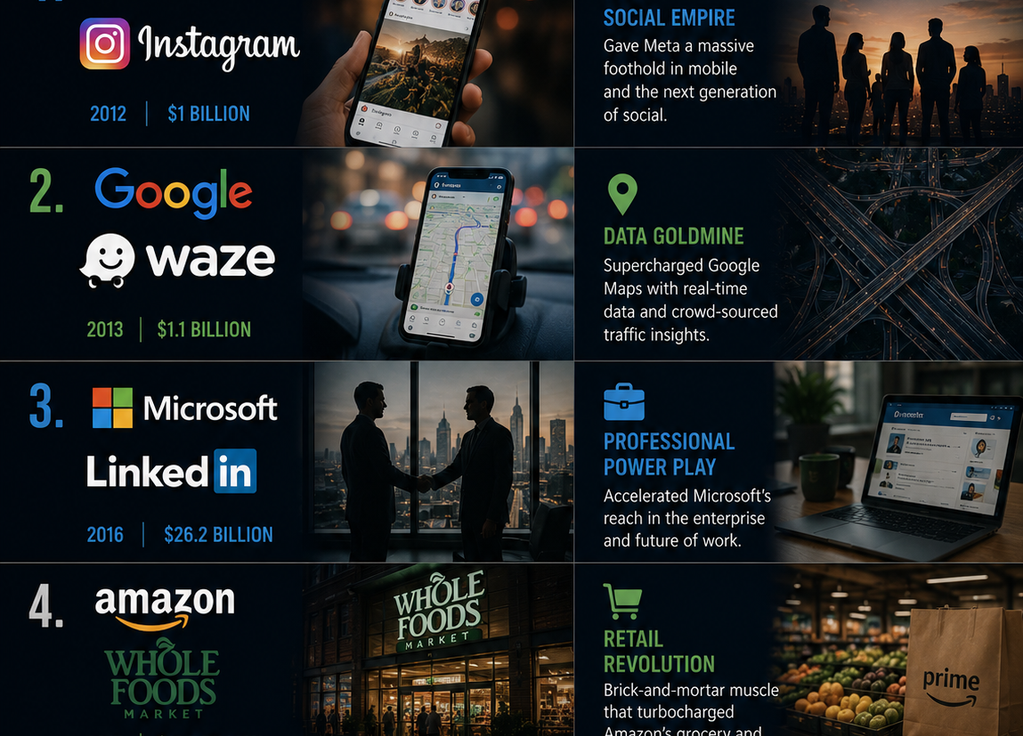
1. Facebook Buying Instagram Changed Social Media Forever
When Facebook acquired Instagram in 2012 for around $1 billion, many people thought the price sounded absurd.
At the time, Instagram was still a relatively small photo-sharing app with only a handful of employees and no major revenue system. Critics questioned why Facebook would spend so much money on what looked like a simple mobile photography platform.
In hindsight, the acquisition became one of the smartest deals in tech history.
Instagram eventually evolved into one of the world’s most influential social media platforms, dominating influencer culture, digital advertising, creator economies, and visual online communication. The deal also helped Facebook prevent a major future competitor from growing independently.
2. Google’s YouTube Purchase Reshaped Entertainment
When Google bought YouTube in 2006 for $1.65 billion, online video still felt uncertain and chaotic.
YouTube was growing quickly, but many people doubted whether user-generated video platforms could become sustainable businesses. Concerns around copyright issues, moderation, and monetization made the acquisition feel risky at the time.
Today, YouTube is one of the most powerful media platforms in the world.
The site transformed entertainment, education, music, journalism, and creator culture globally while generating enormous advertising revenue for Google. It also fundamentally changed how people consume video content online.
3. Microsoft Buying LinkedIn Quietly Changed Professional Networking
Microsoft’s 2016 acquisition of LinkedIn for over $26 billion initially felt less exciting than many other Silicon Valley deals.
LinkedIn was often viewed simply as a professional networking platform rather than a major cultural force. But Microsoft recognized the long-term value of combining workplace software, enterprise services, and professional identity systems together.
Over time, the acquisition strengthened Microsoft’s position deeply inside the business world.
LinkedIn became increasingly integrated into hiring, recruitment, online learning, digital networking, and professional branding while helping Microsoft expand its enterprise ecosystem far beyond traditional software products.
4. Apple’s Acquisition of Siri Accelerated the AI Assistant Era
Before Siri became part of the iPhone, it existed as a small independent startup focused on voice assistant technology.
Apple acquired Siri in 2010 and later integrated it directly into iOS, helping popularize the idea of AI-powered digital assistants for mainstream consumers. At the time, voice assistants still felt futuristic and experimental.
The acquisition quietly helped trigger a massive industry shift.
After Siri’s success, competitors rushed to develop their own AI assistants, eventually leading to products like Google Assistant, Alexa, and broader consumer adoption of voice-based AI interaction.
5. Amazon Buying Whole Foods Signaled a Bigger Strategy
When Amazon acquired Whole Foods in 2017 for nearly $14 billion, many people viewed it simply as an online company entering grocery retail.
But the acquisition represented something much larger.
Amazon used the deal to expand its physical retail presence, strengthen logistics infrastructure, improve delivery systems, and gather more data about consumer shopping behavior. It also demonstrated that tech companies increasingly wanted influence far beyond software and digital services alone.
The acquisition blurred the line between technology companies and traditional industries even further.
Big Tech Often Grows by Buying Innovation
One reason these acquisitions matter so much is because major tech companies frequently expand by purchasing emerging innovation instead of building everything internally.
Large corporations often identify fast-growing startups early and acquire them before they become serious competitors. This strategy allows companies to move quickly into new markets while reducing competitive threats simultaneously.
In many cases, acquisitions became one of the most powerful growth strategies in Silicon Valley.
Some of the world’s biggest platforms might look completely different today without these purchases.
Small Startups Sometimes Become Global Infrastructure
Many acquired startups originally seemed small, experimental, or niche.
Instagram focused on photos. YouTube hosted amateur videos. Siri explored voice interaction. Yet over time, these products evolved into infrastructure used daily by billions of people worldwide.
This reflects how difficult it can be to predict which technologies will eventually reshape culture and business globally.
Ideas that initially appear minor sometimes become foundational parts of modern digital life.
Acquisitions Also Increased Concerns About Monopoly Power
As Big Tech companies continued buying competitors aggressively, governments and regulators began paying closer attention.
Critics argue that some acquisitions reduced competition by allowing giant companies to absorb rising threats before they could grow independently. The Facebook-Instagram deal especially became central to debates about antitrust laws and tech monopoly power.
These concerns intensified as major platforms gained increasing control over social media, advertising, cloud computing, search, and online infrastructure.
The debate now centers not only on innovation, but also on how much power a small number of companies should hold over the digital world.
Some of Tech’s Biggest Changes Happened Quietly
Not every major technological shift arrives through dramatic announcements or revolutionary inventions.
Sometimes the biggest transformations happen quietly through acquisitions that initially seem minor compared to their eventual impact. Over time, these purchases reshape industries, culture, communication, and consumer behavior in ways few people fully anticipate at first.
And in many cases, the future of technology was shaped not only by the companies that invented ideas — but by the giants that bought them at exactly the right moment