
The Real Reason Big Companies Keep Buying Smaller Ones
Laurie Lucas
May 27, 2026
In the modern business world, some of the most important deals happen quietly behind the scenes.
Large corporations constantly acquire smaller companies, startups, apps, and technologies — sometimes for billions of dollars. To the public, these acquisitions can seem confusing, especially when giant companies spend enormous amounts of money buying businesses that appear relatively small or unknown.
But for major corporations, acquisitions are often not just about buying products.
They are about buying talent, eliminating competition, entering new markets, controlling future technology, and accelerating growth faster than building everything internally. In many industries, acquisitions became one of the most powerful strategies for staying dominant in rapidly changing markets.
Key Takeaways
- Big companies often buy startups to grow faster and reduce competition
- Acquisitions can provide access to technology, talent, and new markets
- Buying companies is often faster than building products internally
- Some acquisitions are defensive moves against future rivals
- Tech giants increasingly rely on acquisitions to maintain dominance
1. Buying Innovation Is Faster Than Building It
One major reason corporations acquire smaller companies is speed.
Developing new technology internally can take years of research, hiring, testing, and financial risk. Meanwhile, startups often move faster because small teams can experiment more aggressively and adapt quickly without large corporate structures slowing them down.
When a startup creates something promising, larger companies sometimes find it easier to simply buy the business rather than compete with it directly.
This allows corporations to instantly gain access to products, patents, engineering teams, and technology already proven to work.
2. Acquisitions Help Eliminate Future Competition
Some acquisitions happen because large companies recognize potential threats early.
A fast-growing startup may not seem dangerous initially, but major corporations often look years ahead. If a smaller company shows signs of disrupting an industry or attracting users rapidly, larger competitors may acquire it before it grows powerful enough to challenge them independently.
This strategy became especially common in the tech industry.
Companies like Meta, Google, Amazon, and Microsoft repeatedly purchased startups operating in areas they considered strategically important for the future.
3. Talent Is Often More Valuable Than the Product
Sometimes companies buy startups mainly for the people behind them.
Highly skilled engineers, researchers, designers, and executives are extremely valuable, especially in industries like artificial intelligence, cybersecurity, and software development. Acquisitions can become a shortcut for recruiting entire teams of talented workers at once.
In Silicon Valley, this practice is sometimes called an “acqui-hire.”
The product itself may eventually disappear, but the talent joins the larger company’s internal operations and future projects instead.
4. Big Companies Want Control Over Emerging Markets
Acquisitions also help corporations expand into industries where they currently have weak positions.
Rather than starting from scratch, companies can buy businesses that already understand specific markets, customer behavior, or technologies. This allows corporations to diversify more quickly and reduce the uncertainty involved in entering unfamiliar industries independently.
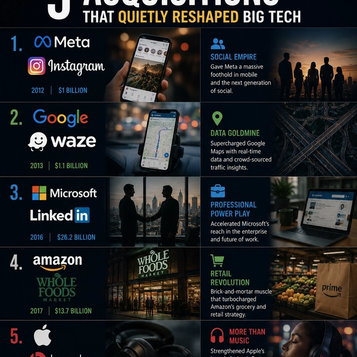
Amazon buying Whole Foods helped expand its physical retail presence. Microsoft’s LinkedIn acquisition strengthened its role in professional networking and business services. Google’s YouTube acquisition helped secure dominance in online video.
Many acquisitions are really long-term strategic positioning moves.
5. Investors Reward Aggressive Expansion
Public companies face enormous pressure from investors to continue growing constantly.
Acquisitions help corporations demonstrate expansion, innovation, and market dominance to shareholders. Buying startups can create excitement around future growth opportunities, especially in fast-moving industries like AI, cloud computing, or biotechnology.
In some cases, the perception of future potential matters almost as much as immediate profits.
Large acquisitions often signal that a company intends to control important emerging technologies before competitors do.
Tech Companies Became Especially Acquisition-Focused
The technology industry relies heavily on acquisitions partly because innovation moves so quickly.
Startups frequently create new platforms, apps, or technologies before large corporations can react internally. Rather than risking irrelevance, tech giants increasingly monitor startup ecosystems closely and purchase promising companies aggressively.
Some of the world’s biggest digital platforms originally began as independent startups before being absorbed into larger corporate ecosystems.
Instagram, YouTube, WhatsApp, and Twitch are all examples of acquisitions that eventually became central parts of Big Tech infrastructure.
Not Every Acquisition Succeeds
Despite enormous spending, acquisitions often fail.
Some companies struggle to integrate different work cultures, management styles, or technologies successfully after purchases occur. Others overpay for startups that never achieve expected growth or profitability.
In some cases, acquired companies lose the creativity and speed that originally made them successful once they become part of large corporate systems.
Buying innovation does not always guarantee companies can preserve it effectively.
Governments Are Increasingly Concerned About Monopoly Power
As large corporations continued aggressively acquiring competitors, regulators around the world started paying closer attention.
Critics argue that some acquisitions reduce competition and allow powerful companies to dominate industries too heavily. Concerns about monopoly power became especially strong in technology, where a small number of corporations control huge portions of digital communication, advertising, cloud infrastructure, and online commerce.
Governments increasingly debate whether some acquisitions should be blocked entirely to preserve healthier competition.
The issue is no longer only economic — it also affects innovation, consumer choice, and control over digital infrastructure.
Acquisitions Quietly Shape Modern Industries
Many of the products people use every day exist because of acquisitions that most users barely remember happening.
Large corporations continuously reshape industries by absorbing startups, technologies, and talent into broader ecosystems. Sometimes these deals improve products and accelerate innovation. Other times, they reduce competition and further consolidate power.
Either way, acquisitions became one of the most important forces shaping the modern business world.
And in many industries today, the biggest companies do not stay powerful only by inventing the future themselves; they often stay powerful by buying it before someone else does.