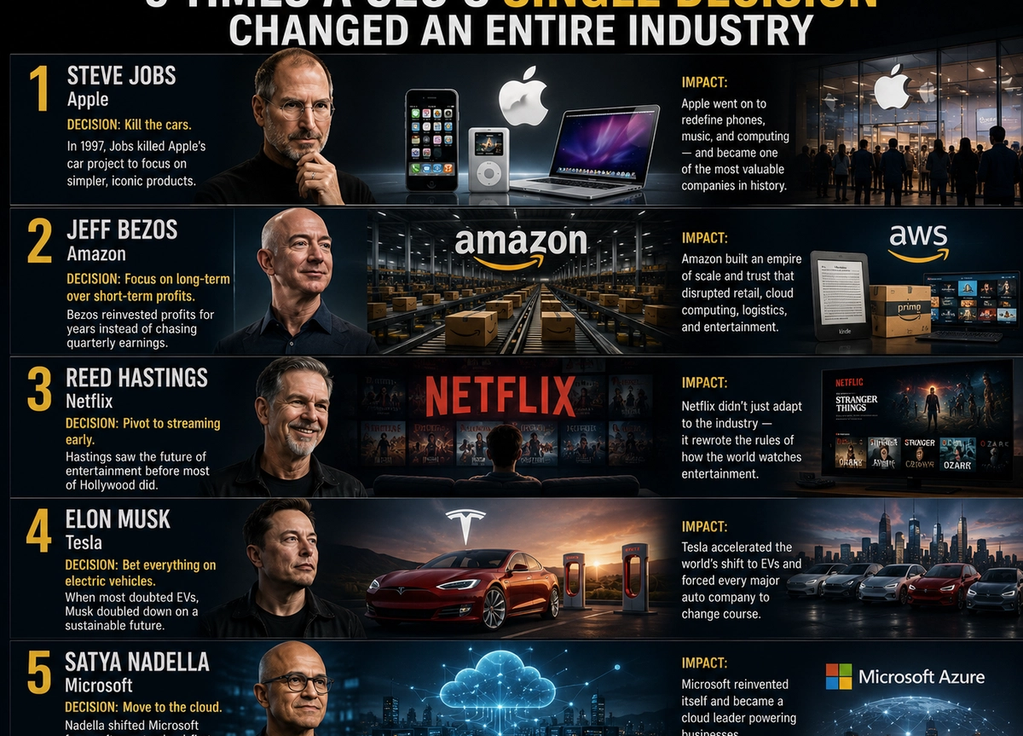
5 Times a CEO’s Single Decision Changed an Entire Industry
Laurie Lucas
May 27, 2026
Some business decisions affect only one company.
Others reshape entire industries.
Throughout modern business history, a handful of CEOs made bold choices that completely changed how people use technology, consume media, shop, communicate, or interact with global brands. In many cases, these decisions looked risky, controversial, or even irrational at the time.
But years later, they became defining turning points that permanently altered the direction of entire markets.
These moments reveal how much influence a single executive decision can have when it happens at exactly the right moment.
Key Takeaways
- Certain CEO decisions reshaped entire industries permanently
- Risky choices often looked questionable at first
- Timing played a major role in industry transformation
- Technology and consumer behavior shifted rapidly after these decisions
- Some corporate bets changed global culture far beyond business alone
1. Steve Jobs Betting Everything on the iPhone
When Steve Jobs introduced the iPhone in 2007, smartphones already existed.
Companies like BlackBerry and Nokia dominated the mobile market, and many people initially doubted whether consumers needed expensive touchscreen devices without physical keyboards. But Jobs believed phones would eventually become portable computers central to everyday life.
Apple’s decision to focus aggressively on the iPhone completely transformed the technology industry.
The smartphone revolution reshaped communication, photography, entertainment, social media, navigation, shopping, and internet culture globally. Entire industries — including app development, mobile advertising, and digital services — exploded because of Apple’s gamble on touchscreen computing.
2. Reed Hastings Turning Netflix Into a Streaming Company
Netflix originally operated as a DVD rental-by-mail business.
But CEO Reed Hastings realized physical media would eventually disappear as internet infrastructure improved. In the late 2000s, Netflix made the risky decision to pivot heavily toward online streaming even though the business model still looked uncertain and streaming technology remained limited.
The decision eventually changed entertainment forever.
Streaming disrupted cable television, movie rentals, theaters, and traditional broadcasting while completely transforming how audiences consume media. Today, nearly every major entertainment company operates streaming platforms partly because Netflix forced the industry into a digital future earlier than many competitors expected.
3. Jeff Bezos Prioritizing Long-Term Growth Over Short-Term Profit
For years, Amazon faced criticism because the company focused heavily on expansion rather than maximizing short-term profits.
CEO Jeff Bezos repeatedly reinvested revenue into logistics, infrastructure, cloud computing, delivery systems, and technological experimentation instead of prioritizing immediate shareholder returns. Many critics believed the strategy was too aggressive and financially dangerous.
Instead, Bezos helped redefine modern e-commerce completely.
Amazon’s obsession with scale, convenience, and infrastructure transformed global retail expectations. Fast shipping, online shopping ecosystems, cloud computing services, and massive digital marketplaces became industry standards partly because competitors were forced to adapt to Amazon’s model.
4. Satya Nadella Shifting Microsoft Toward the Cloud
When Satya Nadella became Microsoft CEO in 2014, the company was still heavily associated with Windows software and personal computers.
Nadella recognized that the future of technology was moving toward cloud computing, AI services, and subscription-based platforms rather than traditional software sales alone. Under his leadership, Microsoft aggressively expanded Azure and shifted company's strategy toward cloud infrastructure.
This decision helped revive Microsoft’s position as one of the world’s most powerful technology companies.
Cloud computing eventually became one of the most important foundations of the modern internet economy, reshaping how businesses store data, run software, and build digital systems globally.
5. Howard Schultz Turning Starbucks Into a “Third Place.”
Before Howard Schultz transformed Starbucks, coffee in America was often viewed primarily as a cheap commodity rather than an experience.
Schultz believed Starbucks could become more than a coffee retailer. Inspired by Italian café culture, he envisioned stores functioning as comfortable social spaces between home and work — what he called a “third place.”
That decision changed global coffee culture dramatically.
Starbucks helped popularize premium coffee shops worldwide while influencing urban culture, remote work habits, café aesthetics, and consumer expectations surrounding coffee itself. Countless modern coffee chains now follow models Starbucks helped normalize globally.
Big Industry Shifts Often Start With Risk
One common pattern connects many transformative CEO decisions: they initially looked risky or unpopular.
Major industry changes rarely feel obvious at the beginning because they involve betting on future consumer behavior before the market fully evolves. Leaders who reshape industries often succeed because they recognize shifts earlier than competitors do.
In many cases, these CEOs were willing to accept criticism or uncertainty long before results became visible.
That willingness to take strategic risks often separates industry-defining companies from businesses that eventually fall behind.
Technology Accelerated the Impact of Leadership Decisions
Modern industries change faster partly because technology amplifies the consequences of business decisions globally.
A successful strategic shift can now influence billions of consumers, international markets, and entire ecosystems almost immediately through digital infrastructure, social media, and global connectivity.
This makes executive leadership more influential than ever in shaping industries rapidly.
One decision inside a boardroom can eventually affect how millions of people communicate, shop, work, or consume entertainment worldwide.
Not Every Bold Decision Succeeds
Of course, history also contains countless risky decisions that failed completely.
For every successful transformation, many CEOs made aggressive bets that damaged companies, wasted billions, or misunderstood market trends entirely. What makes successful decisions appear obvious today is often hindsight.
At the moment they happened, many industry-changing moves involved enormous uncertainty.
Success often depended not only on vision but also on timing, execution, infrastructure, and changing consumer behavior.
One Decision Can Reshape the Future
The most powerful CEO decisions often succeed because they anticipate where the world is already moving before most people fully recognize it.
Whether through smartphones, streaming, cloud computing, online retail, or modern café culture, certain leaders made choices that permanently altered industries and everyday life itself.
And while technology and markets continue evolving rapidly, history repeatedly shows that sometimes a single decision, made at the right moment by the right person, can quietly change the direction of an entire industry forever.