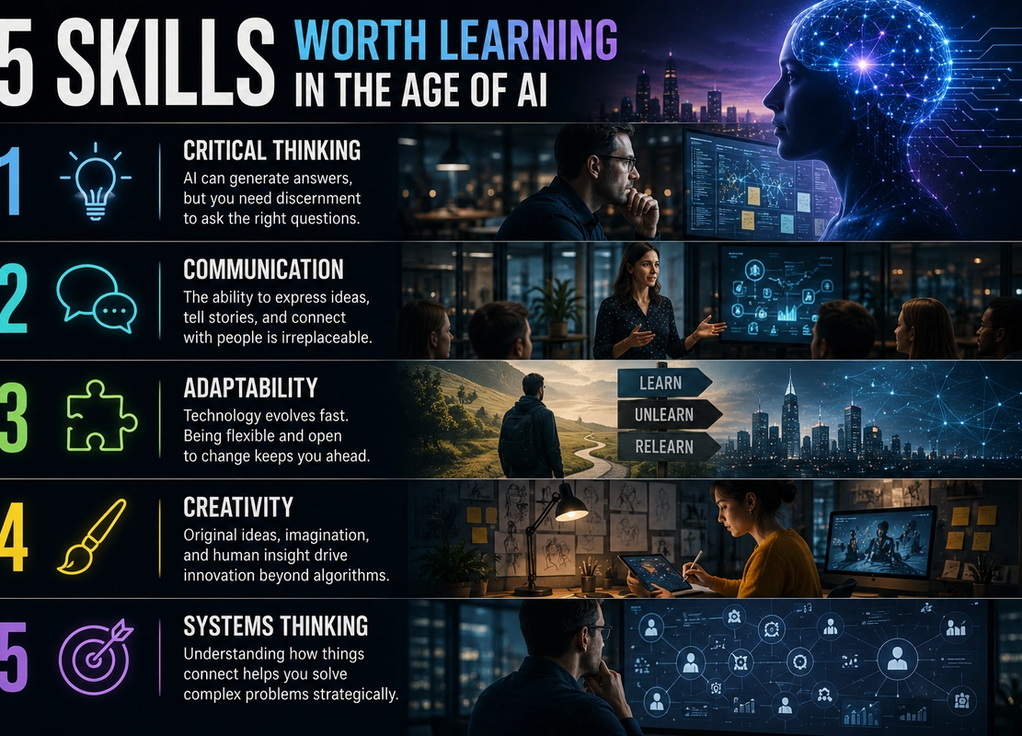
5 Skills Worth Learning in the Age of AI
Sarah Lee
May 27, 2026
Artificial intelligence is changing how people work faster than almost any technology before it.
AI systems can now write text, generate images, analyze data, automate tasks, and assist with coding, research, customer service, and content creation. As these tools become more powerful, many people are wondering which skills will actually remain valuable in a world where machines can increasingly perform cognitive tasks once reserved for humans.
The answer is not simply “learn coding” or “compete with AI.”
Instead, the most valuable skills in the AI era are often the ones that technology struggles to fully replicate: human judgment, creativity, communication, adaptability, and emotional intelligence. As automation expands, uniquely human abilities may become even more important rather than less.
Key Takeaways
- AI is changing the job market and workplace expectations rapidly
- Human-centered skills are becoming increasingly valuable
- Adaptability matters more than memorizing static information
- Creativity and critical thinking remain difficult to automate fully
- Learning continuously may become one of the most important long-term skills
1. Critical Thinking and Problem Solving
AI can generate enormous amounts of information quickly, but it does not truly “understand” situations the way humans do.
People who can evaluate information carefully, recognize nuance, ask strong questions, and make thoughtful decisions will remain extremely valuable. As AI-generated content becomes more common, the ability to distinguish good information from misleading or low-quality output becomes increasingly important.
Critical thinking also helps people work effectively alongside AI tools instead of relying on them blindly.
The future workplace will likely reward individuals who can combine technological assistance with strong human judgment and reasoning.
2. Communication Skills
Clear communication is becoming even more important in an AI-driven world.
Technology may automate certain technical tasks, but businesses still depend heavily on people who can explain ideas clearly, build relationships, negotiate, collaborate, and communicate emotionally with others. Strong writing, speaking, and interpersonal skills remain difficult to replace fully through automation.
This applies across industries.
Whether someone works in business, healthcare, education, marketing, leadership, or technology itself, the ability to communicate clearly and thoughtfully continues to create enormous professional value.
3. Adaptability and Learning New Skills Quickly
The modern job market is evolving rapidly.
Industries, software tools, and workplace expectations are changing faster than ever, partly because AI accelerates technological transformation continuously. This means adaptability itself may become one of the most important long-term skills people can develop.
Instead of relying on one fixed set of knowledge forever, workers increasingly need the ability to learn new systems, adjust to changing environments, and stay flexible as industries evolve.
People who can adapt quickly often handle technological disruption better than those relying only on static expertise.
4. Creativity and Original Thinking
AI can generate content extremely fast, but human creativity still matters deeply.
Original ideas, storytelling, emotional insight, artistic vision, humor, and cultural understanding remain difficult for machines to replicate authentically. Creativity is not only important in artistic fields — it also drives innovation, branding, leadership, entrepreneurship, and problem-solving across industries.
As AI automates repetitive tasks, uniquely human creative thinking may become even more valuable.
People who can combine imagination with strategic thinking will likely continue standing out professionally.
5. Emotional Intelligence
One major limitation of AI is that it does not genuinely experience emotions, empathy, or human relationships.
Skills involving emotional awareness, leadership, empathy, conflict resolution, and understanding social dynamics remain highly valuable in workplaces and communities alike. Jobs involving trust, caregiving, collaboration, mentorship, and relationship-building depend heavily on emotional intelligence.
In many professions, technical knowledge alone is no longer enough.
The ability to understand people, manage emotions, and build meaningful human connection increasingly separates strong professionals from average ones.
AI Will Change Jobs — But Not Eliminate Human Value Entirely
One common fear surrounding AI is the belief that humans will become unnecessary entirely.
While automation will absolutely disrupt many industries and replace certain repetitive tasks, history shows technological revolutions often change work more than they eliminate it completely. New roles, industries, and opportunities typically emerge alongside disruption.
The key challenge is adaptation.
People who learn how to work alongside AI tools rather than ignoring them may gain significant advantages in future workplaces.
Technical Skills Still Matter Too
Although human-centered abilities are increasingly important, technical literacy still matters.
Understanding how AI systems function, how digital tools work, and how technology influences industries can help people stay competitive professionally. Basic familiarity with AI tools, data analysis, digital systems, and automation will likely become useful across many careers.
The future may favor workers who combine technical understanding with strong human skills.
Neither alone is likely enough long term.
Continuous Learning Became Essential
One major shift of the AI era is that learning can no longer stop after formal education ends.
Technology evolves too quickly for people to rely only on degrees or old training permanently. The most resilient professionals are often those who remain curious, adaptable, and willing to keep learning throughout their careers.
This does not necessarily mean constant pressure to become perfect.
It simply means staying open to change and developing the ability to evolve alongside rapidly changing industries.
Human Skills May Become More Valuable, Not Less
Ironically, the rise of artificial intelligence may end up increasing the value of deeply human abilities.
As machines become better at automation, the qualities that remain hardest to replicate — creativity, empathy, communication, judgment, and adaptability — may become even more important economically and socially.
The future of work will likely involve humans and AI working together rather than competing directly in every area.
And in that future, the people who thrive may not be the ones trying to act like machines, but the ones becoming exceptionally good at the things only humans can truly do well.