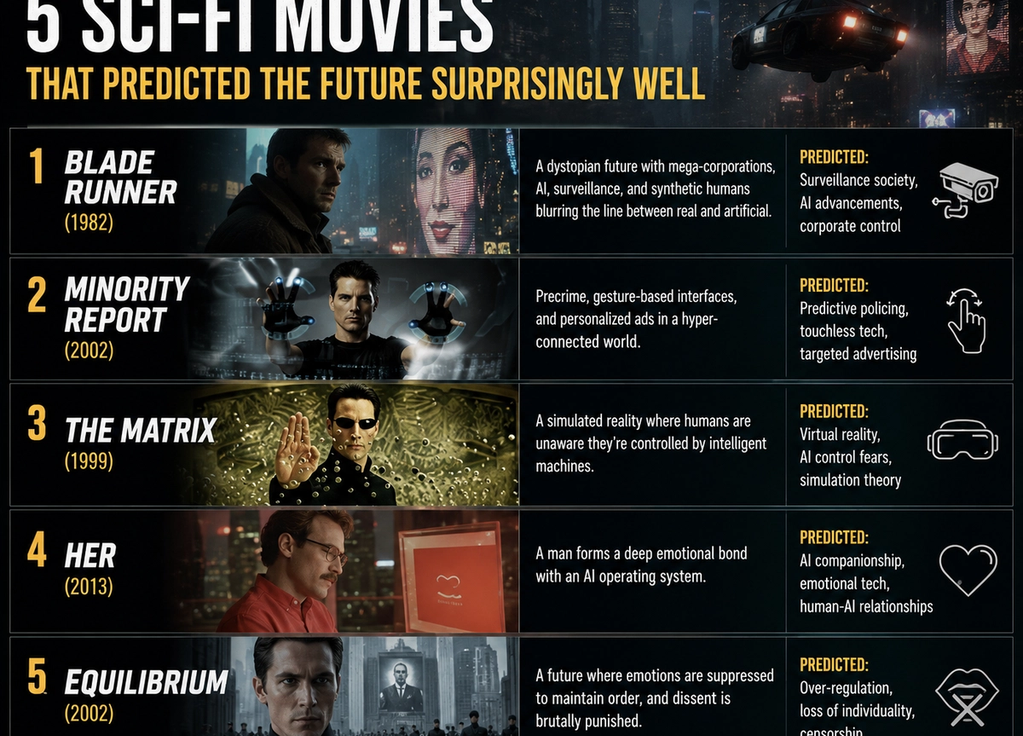
5 Sci-Fi Movies That Predicted the Future Surprisingly Well
Laurie Lucas
May 27, 2026
Science fiction has always imagined what the future might look like.
Some movies created worlds filled with flying cars, robot servants, and intergalactic travel that still feel far away today. But occasionally, certain sci-fi films end up predicting real technological and cultural changes with surprising accuracy.
What once looked unrealistic or exaggerated later became part of everyday life through smartphones, artificial intelligence, surveillance technology, virtual reality, and digital communication.
These films were not perfect predictions, of course. But many captured important ideas about how technology could shape human behavior, society, and culture long before those changes became real.
Key Takeaways
- Some sci-fi films accurately predicted modern technology trends
- Artificial intelligence and surveillance appear frequently in these movies
- Many predictions focused more on human behavior than gadgets
- Social media, virtual reality, and digital dependence were foreshadowed early
- Sci-fi often reflects real fears and possibilities about technological progress
1. The Truman Show Predicted Reality Culture and Constant Surveillance
When The Truman Show was released in 1998, the idea of broadcasting someone’s entire life as entertainment felt absurdly extreme. The film follows Truman Burbank, a man unknowingly living inside a giant reality television program where every moment of his existence is watched by millions.
Today, the movie feels surprisingly relevant in the age of social media, influencers, livestreaming, and constant digital visibility. Many people now voluntarily document large parts of their lives online through platforms designed around public attention and surveillance-like observation.
The film also predicted society’s growing comfort with cameras everywhere. Smartphones, smart devices, and digital tracking systems created a world where privacy often feels increasingly limited.
2. Blade Runner Predicted AI Anxiety and Hyper-Commercialized Cities
Ridley Scott’s Blade Runner imagined a future dominated by artificial intelligence, giant corporations, digital advertising, and blurred lines between humans and machines.
While society does not yet have fully human-like androids, many aspects of the film feel strikingly modern. Massive digital billboards, corporate influence over technology, facial recognition systems, AI assistants, and concerns about what separates humans from machines are now central cultural discussions.
The movie also captured something deeper about modern urban life: overstimulation, technological dependence, and emotional isolation within highly advanced societies.
Its vision of the future now feels less like fantasy and more like an exaggerated version of realities already beginning to emerge.
3. Her Predicted Emotional Dependence on AI
When Her premiered in 2013, the idea of someone developing a deep emotional relationship with an AI operating system seemed unusual and futuristic.
Today, the film feels far less unrealistic.
Modern AI assistants, chatbots, and conversational systems have become increasingly human-like, while millions of people interact with digital companions daily through technology. The movie accurately predicted how AI would evolve beyond simple tools into emotionally responsive systems integrated into everyday life.
More importantly, Her understood something psychological about modern loneliness and technology. It showed how emotionally isolated people might turn toward intelligent digital systems for comfort, validation, and companionship.
4. Minority Report Predicted Personalized Advertising and Predictive Technology
Steven Spielberg’s Minority Report presented a future where technology predicts behavior before it happens. The film is famous for its personalized advertisements that recognize individuals instantly and target them with customized marketing messages.
At the time, this seemed futuristic.
Today, algorithms track browsing behavior, purchases, locations, and online activity constantly in order to deliver personalized ads across digital platforms. Recommendation systems and predictive algorithms now shape much of what people watch, buy, and consume online.
The movie also anticipated growing concerns about surveillance, data collection, and whether predictive systems might eventually influence human freedom and decision-making too heavily.
5. The Matrix Predicted Digital Escapism
The Matrix explored a world where humans become trapped inside an artificial digital reality while losing touch with the physical world around them.
Although society does not literally live inside simulated realities, the film predicted growing dependence on digital environments remarkably well. Modern life increasingly happens through screens, virtual identities, social media platforms, online gaming, and algorithm-driven digital spaces.
The movie’s themes about questioning reality, technology addiction, and passive consumption feel especially relevant today as people spend enormous portions of life inside online environments.
Its central idea — humans becoming deeply disconnected from reality through technology — now feels less symbolic than it once did.
Sci-Fi Often Predicts Human Behavior Better Than Technology
One reason these movies feel so accurate is because they focused less on predicting exact gadgets and more on predicting how humans might behave around technology.
Many sci-fi films understand that technological progress changes psychology, relationships, culture, and social systems just as much as it changes machines themselves.
The best predictions often involve emotional or cultural shifts rather than perfectly accurate inventions.
Technology Usually Arrives Gradually
Interestingly, many futuristic ideas do not appear suddenly in real life.
Instead, technologies slowly evolve until society barely notices how dramatically life changed over time. Smartphones, AI systems, digital surveillance, streaming culture, and algorithmic recommendation systems became normal gradually rather than through one dramatic breakthrough.
This is partly why older sci-fi movies sometimes feel eerily accurate in hindsight.
They exaggerated trends that were already beginning quietly beneath the surface.
Some Predictions Still Feel Warning Signs
Many classic sci-fi films were not celebrating technology uncritically.
Instead, they explored fears surrounding privacy, corporate power, artificial intelligence, isolation, and human dependence on machines. Today, many of those same concerns dominate real conversations about social media, AI ethics, surveillance, and digital well-being.
Science fiction often functions less as prophecy and more as cultural reflection.
These movies asked difficult questions long before society fully realized how relevant those questions would become.
The Future Sometimes Looks Familiar
One of the most fascinating things about science fiction is realizing how often imagination overlaps with reality.
Movies once considered futuristic fantasies now resemble everyday life in surprising ways. AI assistants, targeted advertising, digital dependency, virtual identities, and surveillance technology are no longer distant concepts — they are normal parts of modern society.
And as technology continues evolving rapidly, some of today’s sci-fi stories may eventually feel less like fiction and more like previews of what comes next.